Side Meetings
SMB112
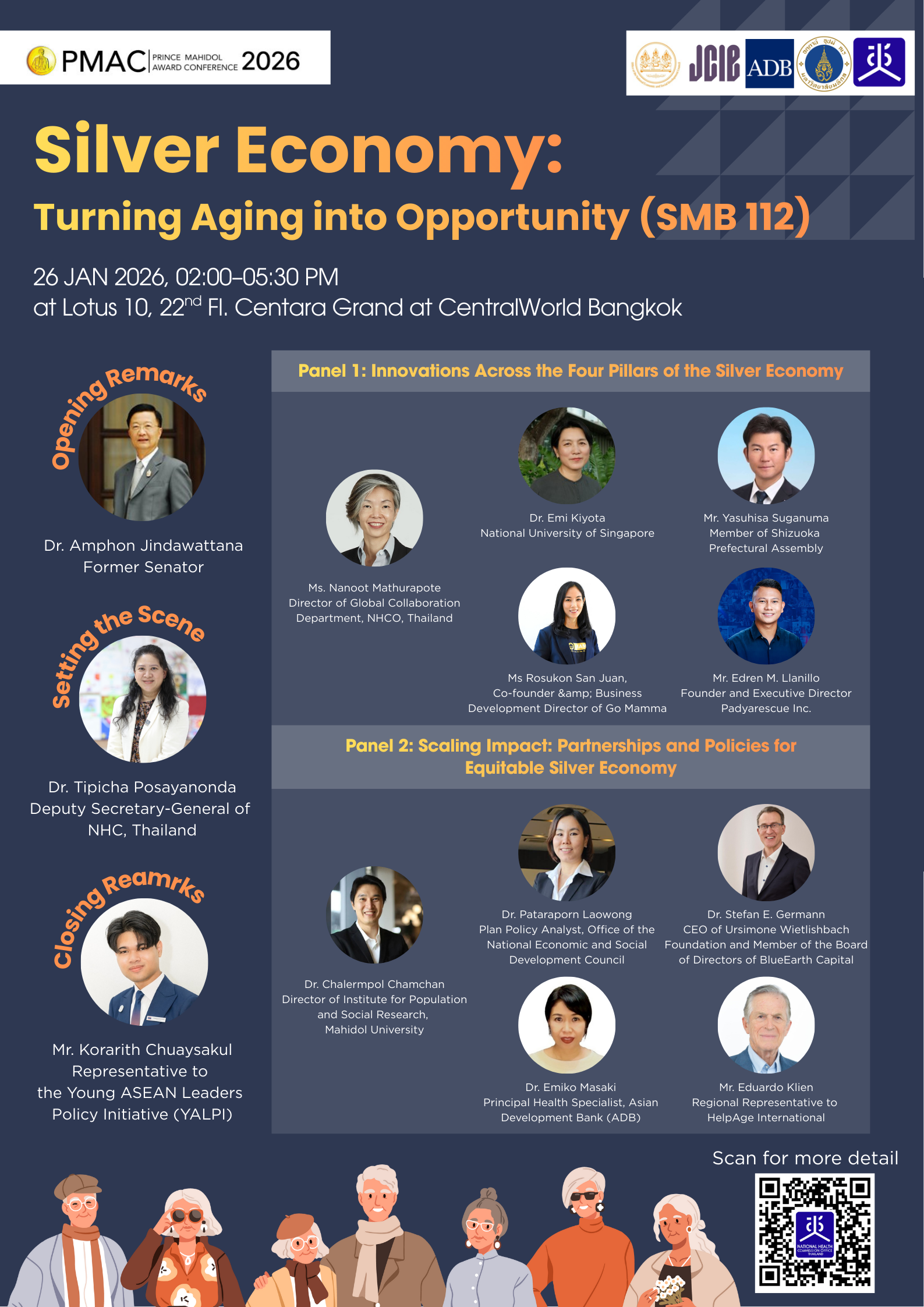
Silver Economy: Turning Aging into Opportunity
26
Jan
-

14:00 - 17:30 HRS. (BKK)
- National Health Commission Office (NHCO), Thailand
- Office of the National Economic and Social Development Council (ONESDC)
- Institute for Population and Social Research (IPSR), Mahidol University
- Japan Center for International Exchange (JCIE)
- Asian Development Bank (ADB)
The silver economy transforms the way we view population aging, shifting the perspective from a burden—rising healthcare costs, pension pressures—to an engine for new markets, jobs, and innovations. Older adults are not only beneficiaries; they are active contributors and discerning consumers whose participation drives economic and social development. In Thailand, the 18th National Health Assembly (NHA 18) recently passed a resolution on the silver economy, outlining four key pillars of development: ensuring work and income security, promoting equitable access to products and services, fostering age-friendly supportive environments, and strengthening action against ageism.
This side event will highlight real-world cases in policies, innovations, and best practices from across Asia that support these four pillars, showcasing how governments, communities, academic, and the private sector are creatively responding to the opportunities of aging societies. Key strategies include:
(1) Enabling older persons to remain in the workforce through legal reforms, incentives, post-retirement employment, reskilling/upskilling, entrepreneurship support, and job-matching platforms;
(2) Promoting goods and services tailored for older persons with equitable access;
(3) Creating age-friendly environments—including accessible infrastructure, transportation, housing, and health systems—that enable independence and participation in society; and
(4) Tackling ageism by reshaping mindsets, reducing stigma, and promoting positive images.
Participants will explore how innovations—from technology to community-based programs—enhance participation, independence, and wellbeing for older adults.
The session will also address and tackle critical challenges to ensure the benefits of the silver economy reach all segments of society.
- Showcase policies, innovations, and best practices across Asia that advance the four pillars of the silver economy: work and income security, equitable access to products and services, age-friendly supportive environments, and action against ageism.
- Generate actionable recommendations to strengthen the silver economy and reduce inequities.