Side Meetings
SMB222
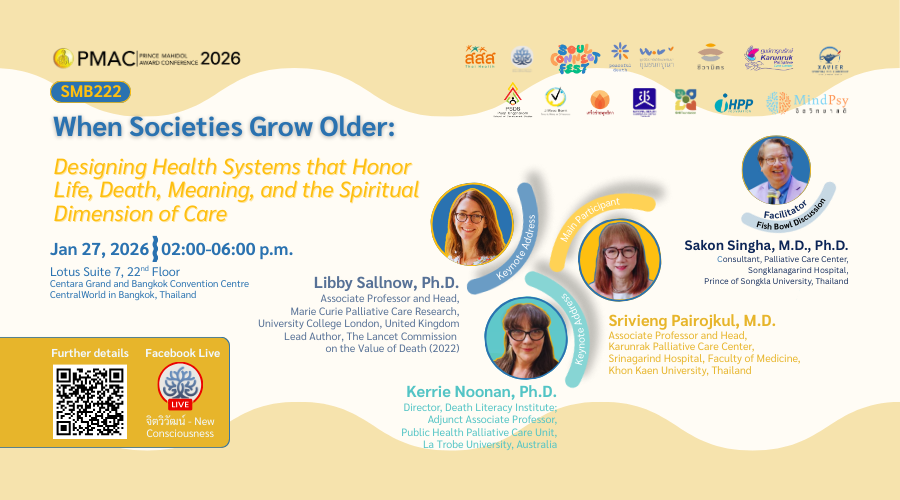
When Societies Grow Older: Designing Health Systems that Honor Life, Death, Meaning, and the Spiritual Dimension of Care
27
Jan
-

14:00 - 18:10 HRS. (BKK)
- Thai Health Promotion Foundation (ThaiHealth)
- Knowledge Center and Coordination on Spiritual Health
- Soul Connect Fest Network
- Peaceful Death
- Compassionate Communities Research and Development Institution Foundation
- Cheevamitr Social Enterprise
- Karunrak Palliative Care Center, Srinagarind Hospital, Faculty of Medicine, Khon Kaen University
- JitArsa Volunteer Development Bank (JitArsa Bank)
- International Health Policy Program Foundation (IHPP Foundation)
- National Health Commission Office (NHCO)
- Society and Health Institute (SHI)
- Buddhika Network Foundation
- Xavier Spiritual and Leadership Development Center (SLDC)
- Puey Ungphakorn School of Development Studies, Thammasat University
- Mindfulness Psychology (Social Enterprise) Co., Ltd.
Across the world, we are living through one of the most profound demographic transitions in human history. Advances in modern medicine have successfully extended life expectancy, while birth rates continue to decline, pushing many societies into an aging era. Yet longer lives do not always mean better lives. For many older adults, especially in the final stages of life, these extra years are often accompanied by chronic illness, vulnerability, loneliness, and emotional disconnection — challenges that our current systems are not fully prepared to hold with care.
Many people today continue their final journey carrying unseen suffering — fear, uncertainty, a sense of being a burden, or a quiet belief that their worth has faded. Meanwhile, care systems often focus on prolonging life rather than honoring the meaning, dignity, and inner world of the person. As a result, far too many lives end in isolation, even when the heart still longs to be understood, to reconcile, to express love, or simply to be accompanied with presence.
This is not only a matter of medical treatment. It is about how we, as societies, design systems that care for life, and systems that care for death.
A compassionate Death System includes knowledge, communication, decision-making, supportive relationships, meaningful rituals, and spaces that uphold dignity and choice — allowing people to leave this world in the way their heart wishes.
At the same time, spiritual health, often overlooked, is essential to whole-person care. It embraces meaning, hope, peace, forgiveness, belonging, and connection with something deeper than the physical body. When this dimension is absent, care remains incomplete, especially at the end of life — where the deepest questions are not medical, but existential.
Equity is also a critical concern. Not everyone has the same opportunity to choose how, where, and with whom they spend their final moments. Access to palliative care, spiritual support, and compassionate presence still depends heavily on socioeconomic status, geography, culture, and available services. Yet a good death should be a basic human right — not a privilege.
Palliative care and hospice services offer pathways to return humanity to care, through compassionate communication, deep listening, emotional and spiritual support, and creating space for peaceful, meaningful endings. Compassionate Communities further remind us that dying is not solely the responsibility of health professionals — it is a shared human responsibility, where families, communities, and society collectively accompany one another toward the final threshold.
This session invites policymakers, system leaders, practitioners, communities, and lived-experience voices to imagine a future where longer lives are not only medically possible, but emotionally meaningful, spiritually supported, and equitably honored — where we build not only systems that sustain life, but also systems that embrace death with dignity, love, and collective compassion
Please see our agenda: https:www.jitwiwat.com/pmac-2026-side-meeting
1. To create a shared learning and reflection space that deepens collective understanding of care for aging populations, particularly the integration of emotional, spiritual, and dignity-centered perspectives across the continuum of life and end-of-life care.
2. To exchange experiences, insights, and promising practices from health systems, community initiatives, practitioners, caregivers, patients, and families across different cultural and social contexts, in order to broaden what is possible and learn from diverse real-world settings.
3. To explore potential directions and co-design pathways for integrating Spiritual Health and Death System concepts into aging care policies, models of service, and community-based approaches, ensuring that the needs of older adults are met with compassion, meaning, and fairness.
4. To seed future collaboration and multi-sector partnerships by identifying shared interests, potential pilot initiatives, learning networks, and cross-disciplinary cooperation that may continue beyond this side meeting.
Please see our agenda: https:www.jitwiwat.com/pmac-2026-side-meeting